Remembering the Reverend Algernon Gifford
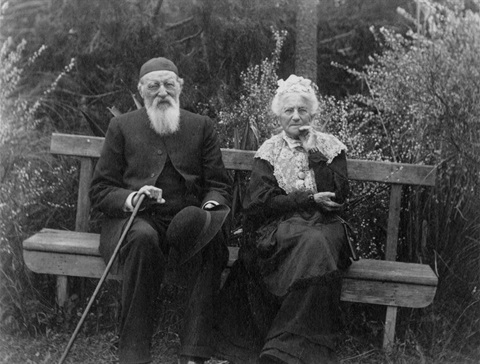
Remembering the Reverend Algernon Gifford
Oamaru Cemetery is the place to go when we want to be reminded of the people of Oamaru’s past. Many of the people buried there made significant contributions to the growth of the town in its early days and the welfare of the people that resided here. One of these people was the Reverend Algernon Gifford, the first Anglican minister for the North Otago region.
Algernon Gifford was born in London in October 1825. He was the third child of twelve, born to Edward and his wife Janet Gifford. He was educated at St Marks College in Chelsea then went on to complete theological training in the harsh climate of Newfoundland, Canada in 1849.
As a young Deacon, Algernon was appointed as the first Anglican missionary to the region of Labrador in Canada. He was escorted to his post in the town of Forteau by his Bishop and then left to complete his mission in the wilderness of Labrador; without a home, friends or means of retreat. In this harshest of climates Algernon managed to establish a congregation, build a church, parsonage and other mission buildings. In 1850 Algernon was ordained Priest and in 1851 he travelled back to England to marry Sarah Anne Evans whom he brought back to Labrador to start a family.
After more than a decade in the harsh climate of Labrador the cold started to have an effect on Algernon and Sarah’s health. Algernon expressed his desire to immigrate to New Zealand and eventually offered his services to the Bishop of Christchurch. In 1862, Algernon Gifford and his family embarked on their journey to New Zealand on the ship Zealandia.
In May of 1862 the Gifford family arrived in Lyttleton. The family stayed with Algernon’s sister in Christchurch for two weeks before embarking on the coastal trip to Oamaru. They arrived off the coast of Oamaru on 15 July 1862 where they were carried ashore to the town that was to be home for the rest of their lives.
Gifford had an expansive parish, it stretched South to Moeraki, North to the Waitaki River and as far west as Lake Ohau. Algernon’s task was a big one, his sermons were held in everything from warehouses to schoolrooms and as good roads were few during this period he spent most of his time travelling between settlements on horseback. Algernon and his horse were known to be inseparable.
The priorities for Algernon in the early days were firstly to establish a residence, and second build a church. The parsonage was built on land given to the church by parishioners William and Fairfax Fenwick. A substantial building was built for the Gifford family of Oamaru stone; it had four rooms on the ground floor and six on the upper floor. The home came to be known as The Glebe, it still stands today on Parsons Road and stands as a reminder of Gifford’s 45 years of service to North Otago.
The next priority for Algernon was the construction of a church. A section was secured on the corner of Tees and Itchen streets. The original church was designed by Messrs Rumsey and Jackson and on Tuesday 20 June 1865 the foundation stone of St Luke’s was laid. The first service was held in the finished church on 29 October 1865, Algernon’s fortieth birthday. The building of the church did not stop there; eventually architects Forrester and Lemon were asked to design an extension to the building. In 1876 the main body was completed and the spire and chancel were completed in December 1912. The last section of the church was consecrated on 26 June 1913, a number of years after Algernon’s retirement and passing.
Algernon’s role as Minister was a busy one; he did not have much time for activities outside the church however he did serve on the local committee for the Dunedin Industrial Exhibition and was an original subscriber to the Oamaru Athenaeum. In regards to the church he was appointed Assessor of the Bishops Court in 1873 and Rural Dean in 1876. In 1887 he was a member of the First Cathedral Commission and clerical representative for the Diocese of Dunedin and the general synods of 1868 and 1886 held in Auckland.
In 1881 the position of Archdeacon of Oamaru was established. Sadly, for everything that Algernon had accomplished for the church in Oamaru, this position was not offered to him; the oversight caused a large amount of controversy. Articles and letters from the general public were published in newspapers and periodicals throughout all of New Zealand. Algernon made an appeal to the Standing Commission of the General Synod to seek clarification of the decisions made. This was the beginning of the end of Algernon’s long association with the church.
In 1889 Algernon Gifford announced to his parishioners that he would be retiring. The church proposed that Algernon and his family reside at The Glebe for the remainder of his life, “free of all rent and charges”. Algernon and his wife lived for a further twenty years at The Glebe after his retirement.
Algernon Gifford passed away at The Glebe on 5 July 1909 aged 84. He was a much loved and well respected citizen who had worked extremely hard for most of his life. He gave his life to the church as a pioneer missionary and minister in Labrador and North Otago and has a significant place in the history of Oamaru. Sarah Anne Gifford passed away 15 July 1913; they were survived by five of their eight children.
Written by Shannan Carr, Curator of Archives, March 2009