Remembering George Sumpter
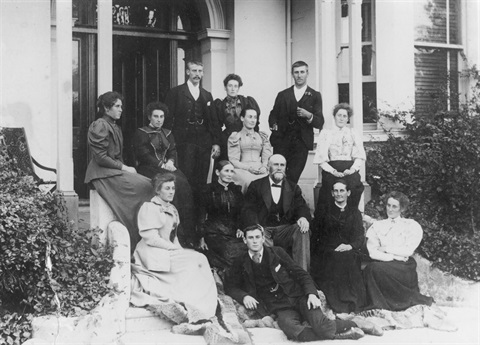
Remembering George Sumpter
Throughout his life in Oamaru George Sumpter was a central public figure. During the late nineteenth century his name was linked with practically every public institution in the town. He died unexpectedly on 11 November 1900, another historic figure destined for Oamaru Cemetery.
George Sumpter was born in Middlesex, England in 1836. By the time he was in his mid-teens he had developed a fondness for the sea and at the age of fifteen received permission from his father to travel to Australia.
Sumpter arrived in Adelaide, South Australia, in 1851. He was first employed as a junior clerk then promoted to gold buyer by the age of sixteen; he remained in Adelaide for 10 years. Towards the end of his time in Adelaide, Sumpter married Susanna Newall and started a family. The family man had also turned to farming pursuits, although news of the discovery of gold in New Zealand rekindled his adventurous spirit and he and his family relocated to New Zealand in 1862.
Sumpter arrived in Port Chalmers on 21 January and went straight to Oamaru where his sister Emma, the wife of John Lemon, lived. Initially Sumpter operated a carrying company that travelled to the goldfields via the Upper Waitaki and the Lindis Pass. This was an important occupation, bringing supplies to settlers; however it was not for the faint hearted, full of risk and danger due to the rough terrain.
Sumpter eventually opted for a more settled occupation and went into business with his brother-in-law; sources indicate that their business, Sumpter and Lemon, was the largest financial institution in North Otago. This partnership lasted a number of years, ending in 1872. Sumpter’s entrepreneurial spirit saw him enter into a number of pursuits including accountancy, insurance real estate, shipping and grain. He had a large grain store built on Harbour Street in 1878; the building now accommodates Willet’s Furniture. Sumpter also had a hand in the establishment of the Woollen Mill in Oamaru through his role as director from 1881 till 1891. He also spent one term as the Woollen Mill’s chairman.
In 1873 Sumpter had architects Thomas Forrester, and his brother in law, John Lemon design him an Oamaru stone villa he called Oakleigh. The house was built on a prominent site overlooking the town in a street now called Oakleigh Crescent, a location once referred to as Sumpter’s Gully. While still a stunning piece of architecture, the pale Oamaru stone has since been painted and the house has had its original porch replaced.
While he was a very successful capitalist, George Sumpter is best remembered for his public pursuits. He was appointed the first town clerk when Oamaru was declared a Borough Council in July 1866, a position he held till 1870. In 1871 he was elected to the Provincial Council of the Waitaki District and held his seat till the abolition of the provinces in 1876. In 1875 Sumpter became Mayor, however he only remained in this position for a year, retiring after an injury he received while fighting a fire.
Sumpter was also involved in the Harbour Board. He was appointed to the Board when it was first established in 1874. In 1876 he became its chairman, a position held for 15 years. During his term he saw the construction of both the Normanby and Sumpter Wharves.
George Sumpter was involved in the Oamaru Rifle Volunteers from its establishment in 1864, working his way up to position of Lieutenant-Colonel in 1889. In 1891 Sumpter was presented with a plate from the citizens of Oamaru in recognition of the interest he had taken in volunteer matters. He was also one of the first committee members of the Athenaeum and Mechanics Institute, spending a number of terms as its president. Sumpter was honoured with life membership of the Athenaeum in recognition of his assistance over the years.
At its inception in 1879, Sumpter was a member of the Waitaki High School Board of Governors, acting as secretary till 1897. He was also heavily involved in St Luke’s Church for over 30 years, eight years of which were spent as Churchwarden and four years as treasurer. He was also a lay reader and superintendent of the Sunday school. Sunday school picnics were often held at his residence Oakleigh. Sumpter was also a Justice of the Peace from 1872 till 1891. He was a keen cricketer and a fan of chess.
Sumpter passed away on 11 November 1900. He had been ill for a number of years, although in the weeks building up to his death his health had improved somewhat, shocking his friends and relatives when his condition suddenly worsened and he was gone.
All information in this article comes from the Waitaki Museum and Archive and local information sources.
Sources for this article:
- McCarthy, Conal (2002). ‘Forrester and Lemon of Oamaru, Architects’, p. 86-7.
- McDonald, K C (date unknown) ‘Newspaper Article - They Once Lived Here, People of the Past – George Sumpter’, North Otago Museum Archive, n. 44361.
- McDonald, K C (1940) ‘History of North Otago, p. 119.
- Roberts, W H S (1896-1906) ‘Newspaper Cuttings - Mr George Sumpter’, North Otago Museum Archive reference, p. 78-79.
- Wise’s New Zealand Directory (1875-76). Advertisements Oamaru, p. 137.
Written by Shannan Carr, Curator of Archives, April 2009