Remembering Thomas Windle Parker
Remembering Thomas Windle Parker
Shanann Carr, Curator of Archives
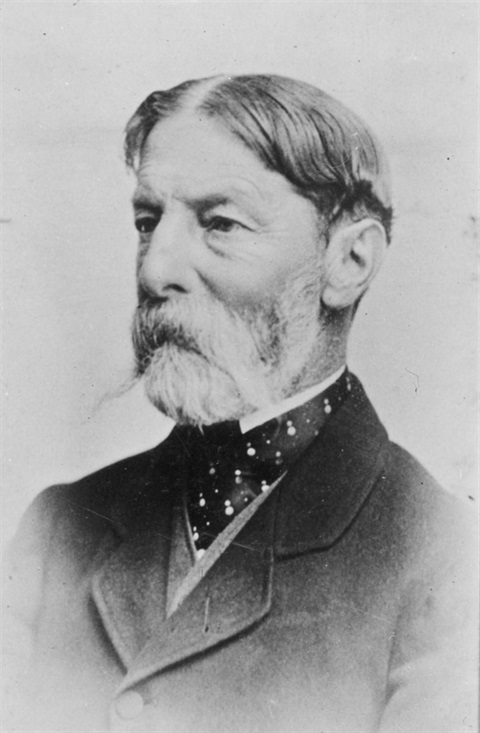
Thomas Windle Parker was an early European settler in North Otago. He arrived in Oamaru in the early 1860s and played an important role in the development of the town. His most significant function was that of resident magistrate, a position he held for close to 20 years. Like many of his peers, Parker has long been at rest in the Oamaru Cemetery.
Parker was born near London in 1809 (although some sources say he was born in 1812); in his late twenties he made the trip to Australia where he became a runholder in the Goulburn district. He held this position for 20 years before heading to New Zealand.
Parker arrived in Otago in 1858, initially gaining work with John Borton and Alexander McMaster who were runholders in the Maerewhenua area. However, Parker was enticed by the news of gold in the Tuapeka region southwest of Dunedin. He relocated to the area and took on the position of gold receiver in 1861. While in Tuapeka, Parker also became resident magistrate.
Towards the end of 1861 he left Tuapeka to become the resident magistrate in Oamaru, it was a newly established position, and one his temporary predecessor, Alfred Strode, had held for only six months. When Parker arrived to take up his new position, Oamaru did not yet have a court house.
The construction of the first court house was commenced in 1862 by George Gammell & Co and completed in 1863. It was a modest structure that sat in the approximate position of the current Oamaru library building. It functioned as the courthouse for 20 years, but was replaced by the current Forrester and Lemon designed courthouse on Thames Street.
Thomas Parker was the resident magistrate of Oamaru for almost 20 years; he also held court in Hampden during the mid 1860s, riding there on horseback every Wednesday morning. The road was long and rough and Parker often found himself delayed, he would ride one horse while leading another. When he reached Herbert he would stable the ridden horse and ride the other horse the rest of the way so he lost no time.
As well as holding the position of resident magistrate, Parker held many other roles that were significant to the development of the town. He became both the registrar of births, deaths and marriages, and coroner in 1862. In 1863 he became the customs officer for Oamaru. Parker was also the arms licensing officer, the returning officer for elections, and the immigration officer.
In his early days in Oamaru, Parker did a lot to help the growing Anglican population prior to the establishment of an Anglican church. Alongside Charles Traill and William Filleul, he often stood as a lay-reader for the Sunday service until a Vicar was appointed permanently to Oamaru.
Other institutions that Parker was involved in included the Agricultural and Pastoral Association and the Building Society, and he was also the trustee of the Oamaru drill shed and the Hospital Reserves. Parker was also a Justice of the Peace.
Thomas Parker resigned as resident magistrate in May of 1881. He lived at 24 Wansbeck Street until his death on 18 November 1898. In his obituary it states, “he was noted for his straightforwardness, his liberal and just ideas, the reliability of his word, and his true gentility. His life was indeed full of useful lessons to those whom he has left behind.”
Thomas Windle Parker is buried in the Oamaru Cemetery; there is no mention of a wife or children on the headstone.
All information in this article comes from the Waitaki Museum and Archive and local information sources.
Sources for this article:
- McDonald, K C (1940) ‘History of North Otago’.
- Oamaru Mail (18 Nov 1898) ‘Death of Mr T W Parker’, p. 3
- Roberts, W H S (1896-1906) ‘Mr Thomas Windle Parker’, W H S Roberts Newspaper Clippings. North Otago Museum Archive reference, p. 48.
Written by Shannan Carr, Curator of Archives, September 2009.