Remembering Rev Alexander Bruce Todd
Remembering Rev Alexander Bruce Todd
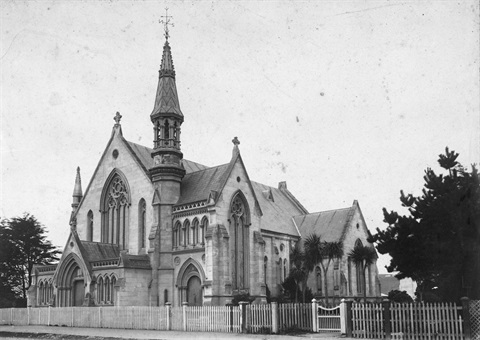
Reverend Alexander Bruce Todd was an early minister of St Pauls Presbyterian church in Oamaru, his tenure lasted twenty-five years. Like many of the prominent figures in Oamaru’s history, Todd is buried in the Oamaru cemetery.
Alexander Todd was born in St Andrews, Scotland on 1 February 1821. His father was a painter by trade, and he was one of seven children. Todd was schooled in St Andrews, and towards adulthood became greatly influenced by Mr Duff, a missionary who had preached at his local parish church. He was further encouraged to pursue a future with the church during the Christian revival inspired by William Burns in the 1830s.
In approximately 1839, after a brief trip to Edinburgh for work, Todd returned to St Andrews to commence study for the ministry, he attended St Andrews University. After only a year at university Todd was struck with a bout of pleurisy; a trip to a country with a warm climate was recommended for healing purposes. Todd took up a position teaching at a school operated by the Free Church of Scotland in Falmouth, Jamaica where he stayed for three years.
On his return to Scotland, Todd went back to his studies, this time at Edinburgh University. He completed his arts curriculum then went on to complete theological studies with the Free Church. Todd was licensed to preach by the Free Church Presbytery of St Andrews in 1855. He was ordained to the office of the ministry in Maybole, Ayrshire in 1858.
On New Years Eve in 1859 Todd married Agnes Train of Dailly, the following day they set sail for New Zealand aboard The Mariner. The couple arrived in their chosen destination of Dunedin six months later; a longer time than usual as they were held up in Nelson for approximately one month.
Todd’s first role as minister was with the Tokomairiro Presbyterian congregation, which covered the area south of Dunedin, including Milburn, Milton, Lovell’s Flat and inland to Lawrence. Todd held this post for approximately 10 years. During this period Todd preached to the gold miners at Gabriel’s Gully.
In 1869 Reverend Todd accepted a call to become minister at St Pauls in Oamaru; his parish included the town of Oamaru, the Waiareka Valley and the Waitaki Valley up to Omarama and Benmore. During the 25 years he spent with St Pauls he paid many visits to those who spent their days working hard within the boundaries of his congregation including run holders, shepherds and miners. Todd also assisted in the formation of a number of Presbyterian churches in North Otago as branches of St Pauls.
In his personal memoires Todd reminisces of wealthy British families sending their wayward children to New Zealand in the hope that it may reform them. In 1878, one such wayward child crossed paths with Reverend Todd, approaching the minister for guidance because he was unable to find work. Todd gave him a little money for something to eat and a place to stay then passed him a note with the details of a man who was looking for employees. The young man went on his way; however a week later the young man was tragically found drowned, floating in the local lagoon. He had the note from Todd still in his pocket, the only clue to his identity.
Alexander Todd lost his wife after 34 years of marriage on 22 November 1892; an event he claimed was the saddest in his life. A few years after her death, when his own health was failing, Todd retired from his post at St Pauls and moved to Dunedin with family. He passed away on 18 August 1903, leaving a daughter and four sons to mourn his loss. Todd was buried with his wife in the Oamaru cemetery.
All information in this article comes from Waitaki Museum and Archive.
Sources for this article:
- Roberts, W. H. S (1903) ‘Obituary’ in Newspaper Cuttings, North Otago Museum Archive reference, p. 120.
- Otago Witness (1903) ‘Obituary, Death of the Rev. A. B. Todd’, p 27.
- Todd, Alex. B (1905) Memorials of the Past: Being the Ministerial Reminiscences of the late Rev. Alex. B. Todd. North Otago Museum Archive, n. 16547.
Written by Shannan Carr, Curator of Archives, 2010.