Remembering Donald Forrester Brown
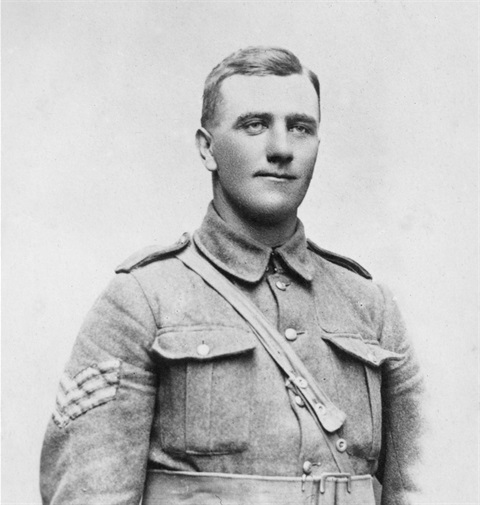
Remembering Donald Forrester Brown
Donald Forrester Brown was the seventh son and youngest child of Jessie and Robert Brown of Polytechnic fame. Sadly, he was killed in battle during World War One, and while his grave is located far away in France, a memorial to him sits in the Oamaru Cemetery, included on his mother and fathers headstone.
Donald Brown was born in Dunedin on 23 February 1890. He was named Donald Forrester after two family friends, Mrs Donald, a friend of Jessie Brown, and Thomas Forrester, an Oamaru architect and friend of Robert Brown. Donald moved to Oamaru with his family in the mid- 1890s where his father set up a successful drapery business and department store which was eventually named the Polytechnic.
Donald was schooled at Oamaru South School before heading to the prestigious Waitaki Boys High School. He became a keen rugby player and remained a student for approximately two years. When he made the decision to conclude his schooling, he moved on to farming. He purchased his own farm in Totara and farmed dairy cows, hens and grew potatoes.
When Donald enlisted for war service he gave his horse and dog away and sold his farm. As part of the North Otago Company, Second Battalion, he was sent to military camp at Trentham near Wellington. From his training in Trentham Donald Brown was posted to Egypt, arriving in January 1916. In April of that year Donald was promoted to the rank of Sergeant, and was eventually moved on from Egypt to fight in France.
After arriving in France, Donald was sent to the area of intense fighting surrounding the River Somme. He fought courageously from the minute he arrived. In September he assisted Sergeant Jesse Rodgers, also of Oamaru, in disabling a machine gun by rushing the gun and immobilising its crew. The pair received much praise for this brave act and were considered heroes by their fellow soldiers. However, on 1 October 1916, when under heavy machine gun fire once again, Donald Brown single-handedly rushed the gun to disable its crew. He immobilised four gunmen and took over the gun but sadly met his end by a sniper’s bullet only 30 minutes later.
On 12 June 1917, seven months after the death of Donald Brown, his father Robert received news that his son had posthumously been awarded the Victoria Cross for ‘conspicuous bravery and determination in attack’. On 30 August, Robert Brown was presented with his sons V. C. during a large military presentation with thousands of onlookers. Donald Brown is the only North Otago serviceman to receive the Victoria Cross to date.
In 1919 a decision was made by the president of the Oamaru beautifying society to plant an oak tree in memory of each North Otago serviceman lost in the Great War. This decision resulted in the planting of the ‘Memorial Oaks’. On 11 September 1919 Admiral Lord Jellicoe dedicated these oaks in a ceremony at the junction of Towey, Wansbeck and Severn Streets. The first tree planted was that dedicated to Donald Brown, and each memorial oak was planted along the streets using Donald’s tree as a centre point.
Donald Brown was only 26 years old when he tragically lost his life. He was initially buried in an isolated grave near Eaucourt l’Abbaye in France, but was eventually moved and laid to rest in Warlencourt New British Cemetery, South West of Bapaume, Plot 3, Row F, Grave 11.
Sources for this article:
- Brown, Eunice (1986) ‘Robert Brown and His Time’. North Otago Museum Archive, n. 61680.
- Brown, Eunice (1998) ‘Your Loving Son, Don’, North Otago Museum Archive, n. 53540.
- Grey River Argus (12 June 1917) ‘Sergeant Browns Biography’, p.3 (on Papers Past website).
Written by Shanann Carr, Curator of Archives, July 2009